
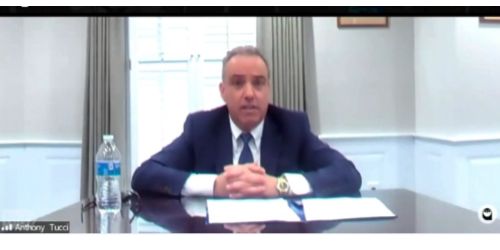
Below are the comments presented by Anthony Tucci at the IACC Full Committee Meeting:
“Thank you to the entire IACC for allowing me the opportunity to submit written comments. I am a parent of a 19-year-old son who has autism and is a non-speaker. I am also the executive director of Autism Awareness and Support Foundation a 501(c)(3) organization that has sought to advocate for autism awareness and support services.
My brief comments include the following concerns and/or recommendations:
I. We need more research and NIH workshops that promote effective interventions to address the unique language and communication challenges of individuals with autism. The lack of sufficient research delays the finding of required insight related to communication
challenges of children with ASD, delays effective interventions, and also delays indentifying prior research findings that may be inconsistent with newer scientific findings. Dr. Tager-Flushberg and Dr. Connie Kasari in their 2013 article entitled “Minimally verbal school-aged children with autism spectrum disorder: the neglected end of the spectrum” recognized the need for this important research (Autism Research 2013 468-478). I am hopeful that IACC will continue to play a key role in promoting and facilitating this vital research. It is of utmost importance that continued research continue to be performed to confirm that non-speakers with ASD can learn and achieve high literacy scores and robust communication development skills from interacting in the environment, without formal, guided instructions.
The recent January 2023 NIDCD conference entitled “Minimally Verbal/Non-Speaking Individuals with Autism: Research Directions for Interventions to Promote Language and Communication” is a great illustration of the type of workshops that are essential to explore the
research needs of this population. I am hopeful these types of workshops will be replicated on an ongoing basis.
II. The research direction for interventions that promote language and communication should be led by an independent and qualified team of multi-disciplinary experts. The Autism CARES Act of 2014 brought attention to the need to expand research and improve
coordination among all NIH agencies that fund ASD research. The same logic which compelled coordination of agencies should hopefully highlight the value of applying a coordinated approach to research conducted by a team of multi-disciplinary experts best suited to address the unique and widely unknown challenges related to communication disorders of individuals with ASD. Research that seeks to promote effective language and communication must begin with a commitment to a best practice methodology that is rooted in integrity and wisdom. To foster and help promote independent and robust scientific research, this research should be undertaken by a
team of multi-disciplinary experts who are able to offer competent and informed knowledge with respect to the unique language and communication challenges of individuals with autism.
Research involving communication and language for individuals with autism should no longer be conducted via a silo approach of expertise. For example, speech and language experts are likely singularly ill-equipped to explain and analyze the current research and knowledge of the neuroscience involved in complex communication disorders. The National Center for Complementary and Integrative Health (NCCIH), National Institute of Health has offered amazing insight on the value of using a multi-disciplinary integrative medicine team in the treatment of many medical disorders.
Hopefully NCCIH and NIDCD can work collaboratively to identify the most appropriate teams of experts that are qualified to conduct meaningful research that will incorporate the highest level of available relevant knowledge within all fields of medical/health care. I have recently addressed these recommendations via email to these esteemed NIH divisions.
III. A humane and ethical foundation must underlie all applications of evidence-based practice models that seek to apply scientific research for the betterment of individuals with ASD. I am hopeful that the IACC can intervene and offer some form of independent governmental oversight to the unbounded actions of some professional and trade associations that seem to be pursuing a form of misguided advocacy against individuals that seek to merely exercise their human right to select a mode of communication that is effective for them. For example, I have carefully studied all aspects of the S2C controversy, and have sadly witnessed the inappropriate
and hurtful conduct of select professionals that oppose it. It is my opinion that this form of misguided advocacy violates the human dignity of individuals with autism and displays a grave example of science and its greatest discontents. Professionals and trade associations serving individuals with autism would be well advised to recognize that their singular knowledge and experience as speech and language experts, ABA providers, etc. represent, at best, single spokes on a large wheel of unknowns. It is my opinion that the IACC goals for meaningful and accelerated scientific progress can only be achieved if all researchers and professionals work collaboratively with an open mind to learn from one another.
I respectfully request that the IACC seek to intervene to help ensure that all governmental agencies, educational programs, clinical practitioners, and relevant trade associations seek to implement evidence-based practice mandates in a manner which does not serve to undermine the human rights, ethical rights, and legal rights of minimally verbal/non-speaking individuals with autism. Human rights, equitable rights and civil rights must lead a proper application of the evidence-based practice model for all interventions aimed to promote language and communication for individuals with ASD.
The communication challenges of non-speakers should never fall victim to unreasonable turf wars between professionals and experts that have opposing views. Moreover, non-speakers should never be condemned for selecting a mode of communication that has proven to be
effective for them.
Thank you”